
Passive and active tracer dynamics in crowded environment:
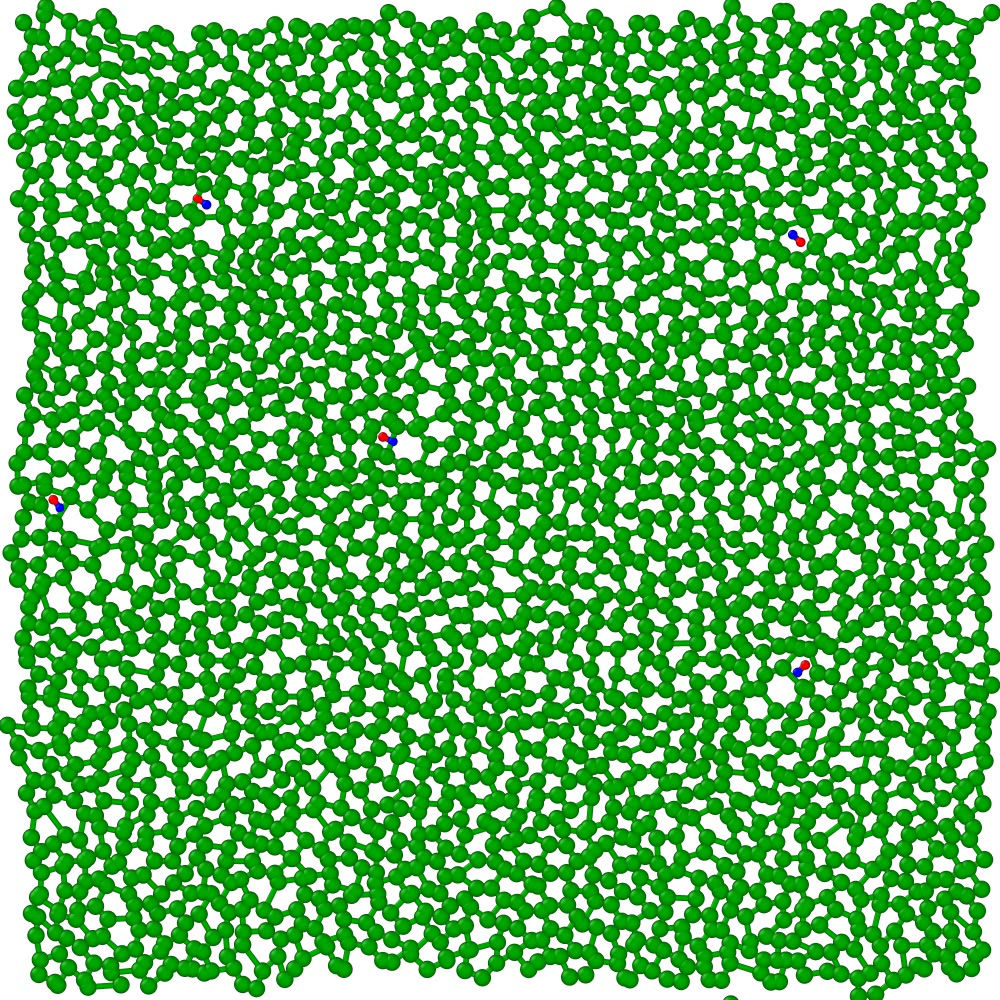
Using molecular dynamics simulations, we investigated tracer diffusion within a polymer matrix featuring specific, trap-like binding zones. Our simulations reveal that the tracer can undergo normal yet non-Gaussian diffusion under specific conditions—namely, when the trapped polymers are immobile and both the volume fraction and binding strength of the traps remain moderate. In this regime, the tracer experiences a heterogeneous environment, exhibiting motion akin to a confined continuous-time random walk (CTRW) that drives the non-Gaussian behavior. Furthermore, long-time dynamics shift to subdiffusive as trap density or binding strength increases. Conversely, when the polymers are mobile, the tracer dynamics remain Gaussian, though they can be normal or subdiffusive depending on trap parameters. We find that increasing the trap density, binding strength, or tracer size systematically enhances the trapping probability; notably, removing the binding zones eliminates trapping entirely, even under high crowding. For larger tracers in a frozen polymer background, the dynamics become highly subdiffusive but only weakly non-Gaussian. These observations align with recent experimental findings on tracer diffusion in polymeric materials, challenging the general validity of Gaussian theories in crowded environments. Building on this, our group has recently explored tracer diffusion in polymer gels—focusing on how tracer size, shape, and gel flexibility induce heavy-tailed, non-Gaussian dynamics. In addition we have also investigated the dynamics of active Janus probes in crowded environments, focusing on the translational-rotational decoupling observed at moderate crowding as well as methods to control the diffusion of non-magnetic active nanoparticles in magnetic fluids using external magnetic fields. More recently, we have started investigating the navigation strategy of soft active agents in porous media.


Representative Publications:
1. In Silico Studies of Active Probe Dynamics in Crowded Media - Ligesh Theeyancheri, Rajiblochan Sahoo, Praveen Kumar and Rajarshi Chakrabarti, ACS Omega 7, 33637 (2022). (Invited Mini-Review).
2. Chemically symmetric and asymmetric self-driven dumbbells in 2D polymer gel - Praveen Kumar, Ligesh Theeyancheri, and Rajarshi Chakrabarti Soft Matter 18, 2663 (2022).
3. Motion of an active particle with dynamical disorder - Koushik Goswami and Rajarshi Chakrabarti Soft Matter 18, 2332 (2022).
4. Transport of a self-propelled tracer through a hairy cylindrical channel: interplay of stickiness and activity - Rajiblochan Sahoo, Ligesh Theeyancheri and Rajarshi Chakrabarti, Soft Matter 18, 1310 (2022).
5. Directing the diffusion of a non-magnetic nanosized active particle with external magnetic fields - Martin Kaiser, Pedro A. Sanchez, Nairhita Samanta, Rajarshi Chakrabarti and Sofia S. Kantorovich, J. Phys. Chem. B 124, 8188 (2020).
6. Translational and rotational dynamics of a self-propelled Janus probe in crowded environments - Ligesh Theeyancheri, Subhasish Chaki, Nairhita Samanta, Rohit Goswami, Raghunath Chelakkot and Rajarshi Chakrabarti, Soft Matter 16, 8482 (2020).
7. Escape of a passive particle from activity-induced energy landscape: Emergence of slow and fast effective diffusion - Subhasish Chaki and Rajarshi Chakrabarti, Soft Matter 16, 7103 (2020). (This article has been featured in an online themed collection: Soft Matter Most Popular 2020).
8. Transport of probe particles in polymer network: effects of probe size, network rigidity and probe-polymer interaction - Praveen Kumar, Ligesh Theeyancheri, Subhasish Chaki and Rajarshi Chakrabarti, Soft Matter 15, 8992 (2019).
9. Tracer Diffusion in a sea of polymers with binding zones: Mobile vs frozen traps - Nairhita Samanta and Rajarshi Chakrabarti, Soft Matter, 12, 8554 (2016). (This article has been featured in an online themed collection: New Frontiers in Indian Research).